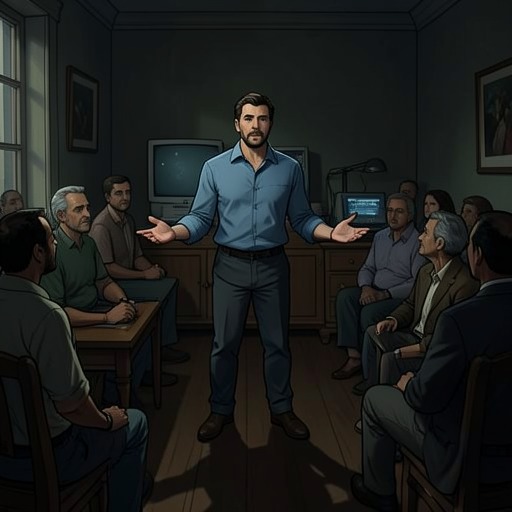
Murder of Ronda Morrison at the dry cleaner
Just MercyThe Murder of Ronda Morrison at the dry cleaner became the center of a prosecution that turned an unsolved killing into a death sentence for Walter McMillian. The account gives little detail about the crime itself; its emphasis falls on how the murder was attributed to McMillian, how that accusation was reinforced in court and in the press, and how investigators eventually rejected it. Their conclusion—that McMillian had nothing to do with the murder—exposed the gulf between the public story of a dangerous killer and the evidence against an innocent man.
The Murder and the Accusation
The murder remained unsolved long enough to become a source of local frustration. Ted Pearson, the district attorney for nearly twenty years, faced criticism that his office had failed to solve it quickly. As he neared retirement, Pearson was determined to leave office with a victory; the prosecution of McMillian became one of the most important cases of his career. In February 1988, the case was scheduled for trial with Ralph Myers as the primary witness and Bill Hooks prepared to testify that he had seen McMillian’s truck at the crime scene.
The case against McMillian was fragile. Pearson knew that many Black residents believed McMillian was innocent, yet remained confident that he could secure a guilty verdict despite doubts about the testimony of Myers and Hooks. The murder’s unanswered questions thus became entangled with an accusation whose key witnesses were already suspect. The eventual investigative conclusion would not merely weaken the case: it would state that McMillian had no involvement in the murder at all.
Race, Courts, and the Jury
The prosecution unfolded within a justice system in which race shaped who could participate in deciding a case. In 1987, all forty elected district attorneys in Alabama were white, even though sixteen counties had Black majorities. Monroe County was about 40 percent Black, but defendants there could still face all-white juries. For generations, officials had kept jury rolls predominantly white through voting-roll exclusions and other tactics, including discretionary peremptory strikes that could remove Black prospective jurors.
A 1986 decision in Batson v. Kentucky offered Black defendants a more direct way to challenge racially discriminatory strikes. But the ruling also gave prosecutors an incentive to find more creative ways to exclude Black jurors. McMillian heard about these practices from other prisoners while held on death row before trial. He left legal strategy to his lawyers, but remained concerned about what kind of jury would hear his case. The murder prosecution therefore carried stakes beyond the evidence about the crime: the composition of the jury could shape whether that evidence received a fair hearing.
The broader history of racial hierarchy also formed part of the account’s context. After federal troops left Alabama in the 1870s, voting rights for African Americans were taken away and racially restrictive laws reinforced white supremacy. Laws against interracial sex and marriage were among the measures used to police intimate relationships and sustain that hierarchy. The narrative describes this history alongside Walter’s relationship with Karen Kelly, but does not establish that the relationship caused the murder accusation. It shows instead how racialized assumptions about Black men and white women could make a Black man’s reputation especially vulnerable to suspicion.
A Dangerous Man in the Press
During the later effort to overturn the conviction, local papers repeatedly presented McMillian as a threat. Newspapers in Monroeville and Mobile called him a drug kingpin, a sexual predator, and a gang leader. Early coverage highlighted the sexual misconduct allegations involving Myers; accounts of the hearings emphasized metal detectors and police stationed in the courtroom. A Brewton headline described McMillian as wanted in another murder, while the Mobile Press Register declared that Ronda was not the only girl killed and reported law-enforcement claims that McMillian led a criminal operation across several counties.
Those claims gave the murder a second life in public: instead of remaining a specific crime to be investigated, it became part of a larger portrait of McMillian as a dangerous criminal. That portrait endured even when evidence presented at a hearing showed he had nothing to do with another murder invoked against him. At a hearing in Baldwin County, supporters of the State walked out rather than hear evidence supporting his innocence. The press’s portrayal and the courtroom security surrounding McMillian reinforced one another, making suspicion appear like proof.
The defense considered seeking national attention, partly because threats raised concern about how safely McMillian could live if released. Publicly explaining the case might help prepare the community for his return and counter the local portrayal of him as guilty. Yet media attention also carried risks: the appeal was pending, and the defense feared that prejudicial coverage could make a fair retrial nearly impossible. The choice to seek national reporting was therefore not a substitute for the appeal but an attempt to change the public account of the murder and its supposed perpetrator.
Investigators Reject the Case
After reviewing files, memoranda, and original evidence, investigators Tom Taylor and Greg Cole came to doubt McMillian’s guilt. Taylor eventually told the defense plainly that McMillian could not have killed Ronda Morrison. He said that the investigators would report to the attorney general, the district attorney, and anyone who asked that McMillian had nothing to do with either murder and was completely innocent.
Taylor’s explanation returned the case to the mismatch between accusation and evidence. McMillian, he observed, worked long days cutting timber on difficult terrain and lived in conditions that made little sense for the criminal kingpin local law enforcement had described. Myers’s trial account, Taylor said, also made no sense. The investigators’ assessment transformed the murder’s place in the story: rather than evidence of McMillian’s guilt, it became the crime around which an unreliable prosecution had been built.
The account’s focus is consequently not a solved reconstruction of Morrison’s death, but the consequences of attributing it to the wrong man. The murder brought a long-standing failure to solve a crime into the courtroom; the prosecution, racial barriers in jury selection, and a sensational public narrative then made the accusation appear durable. The later investigators’ conclusion cut through that narrative and supplied the essential finding: McMillian was innocent of Morrison’s murder.